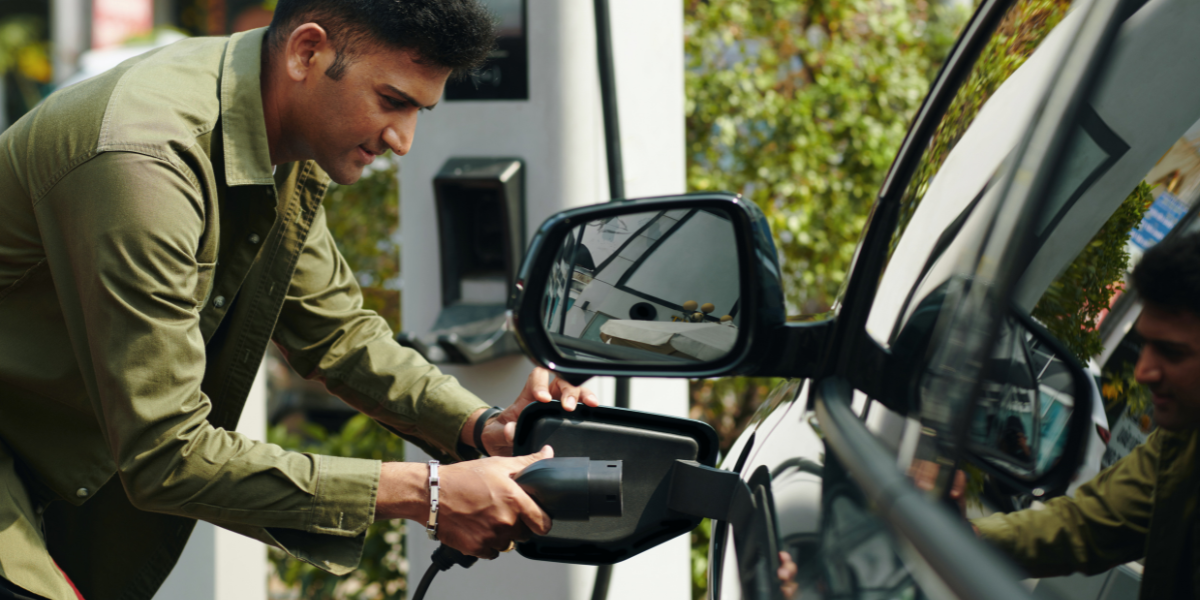

For any new EV owner, standing at a public charging station holding a heavy connector gun can bring on the mild panic of trying to solve a puzzle in public. But the mechanics behind Indian charging infrastructure are far less complex than they appear.
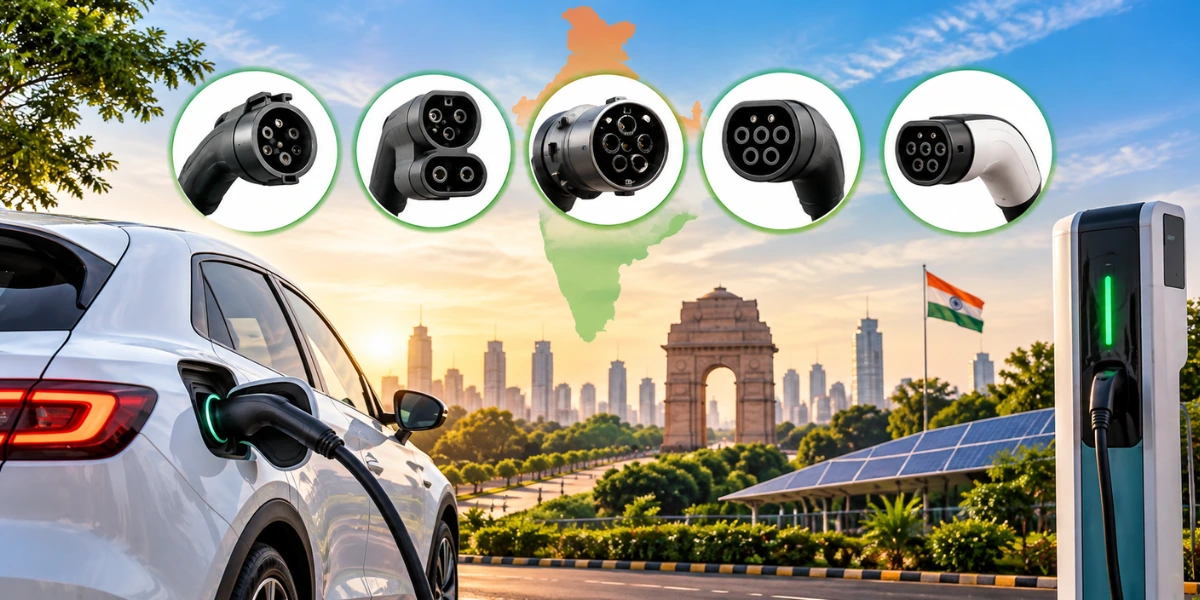
You cannot accidentally damage your vehicle by choosing the wrong plug—physical engineering safeguards ensure an incompatible connector simply will not fit. India settled its national electric vehicle plug standards years ago, streamlining the entire passenger car ecosystem down to three core connections and one clever design trick. In just five minutes, this guide decodes every socket, pin configuration, and cable you will encounter across the country.
Why India Runs on More Than One EV Connector
India's charging infrastructure was built in two distinct phases, and understanding that history is the fastest way to make sense of the sockets you'll encounter today. The first phase, rolled out under early government charging schemes between roughly 2017 and 2019, relied on connector standards adapted from China. The second phase — the one nearly every EV sold today belongs to — has consolidated firmly around European-origin standards. That transition is exactly why some public charging stations still carry three or four different sockets rather than one: the infrastructure is catching up to a market that has already standardised.
The reassuring part is this: for anyone buying or driving a modern EV, the picture is simple. Nearly every mainstream electric car sold in India today — from the Tata Nexon EV and MG Windsor to the Hyundai Ioniq 5 and BMW iX — uses just two connectors: Type 2 for AC charging and CCS2 for DC fast charging. Everything else in this guide is either a legacy standard you may still encounter at older stations, or a connector built for an entirely different vehicle category.
Type 2 (Mennekes) — India's Standard AC Connector
Type 2, also known as the Mennekes connector, is the engineering standard behind the vast majority of home chargers, workplace chargers and slower public charging points across India. It uses seven pins and is purpose-built for alternating current (AC) charging, where the conversion from grid power to battery-ready power happens inside the car's own onboard charger.
- Typical power range: 3.3 kW to 22 kW, though most home installations in India are configured for 3.3–7.4 kW on a single phase.
- Where you'll find it: home wall boxes, apartment and office charging points, and the AC side of most public charging stations.
- Compatibility: effectively universal across modern Indian EVs — if your car was launched in the last few years, it will have a Type 2 inlet.
One detail worth knowing so you can set the right expectations: your actual charging speed on a Type 2 connector is governed by whichever is lower — the charger's rated output or your car's onboard charger capacity. A 22 kW public AC point will not charge a car fitted with a 7.4 kW onboard charger any faster than a 7.4 kW home charger would. Knowing this in advance means no surprises at the charging point.
CCS2 — India's DC Fast-Charging Standard, Built for Speed
CCS2 (Combined Charging System 2) is the standard powering the fast-charging network you'll find along highways and across cities. Physically, it's engineered as the Type 2 connector with two additional, larger DC pins added below it — a single connector supporting two charging modes.
This is the reassurance worth leading with: you never need to check whether your home charger will fit your car. Because CCS2 is built as a Type 2 port with DC pins layered underneath it, the same vehicle inlet accepts a Type 2 AC plug for home charging and a full CCS2 DC gun for fast charging on the road. One port, two charging modes, zero compatibility guesswork.
In India, CCS2 is the connector you'll rely on the moment you pull up to any public fast charger. Because DC charging bypasses the car's onboard converter and delivers power directly to the battery, it moves substantially more energy in far less time — for the full mechanics and 2026 pricing, see our dedicated breakdown of DC fast charging speeds and costs in India.
- Typical power range in India: mass-market stations commonly deliver 30–60 kW; premium stations for cars like the Ioniq 5 or Kia EV6 can offer 120–150 kW.
- Where you'll find it: highway charging corridors, city fast-charging hubs, and a growing number of fleet depots.
- Compatibility: standard on nearly all new passenger EVs sold in India today. CCS2 is the safest, most future-proof choice if you're specifying a DC charger for your own site.
Bharat AC-001 and Bharat DC-001 — India's Early Charging Standards
Before CCS2 became the national standard, India deployed its own charging protocols under early central and state EV schemes. You're most likely to encounter these at older public installations rather than on any current-generation car — and knowing how to identify them keeps you from a wasted stop.
Bharat AC-001 uses an industrial-style IEC 60309 socket — the same rugged blue plug used at construction sites — for slow AC charging up to roughly 3.3 kW per phase. It was engineered primarily for two-wheelers, three-wheelers and small EVs, which is why you won't encounter it on a modern passenger car.
Bharat DC-001 is a modified GB/T-style DC connector delivering up to about 15 kW, used by some early fleet EVs and government-installed public chargers.
Neither standard is compatible with CCS2. If you come across a public charger offering only Bharat AC-001 or Bharat DC-001, you can safely treat it as a legacy installation — it won't serve a modern EV with a Type 2/CCS2 inlet, and new deployments of either standard have become rare.
GB/T — Where It Still Shows Up
GB/T is China's national EV charging standard, with distinct AC and DC connector designs (the DC version uses two thick pins in a rectangular housing, rather than the round pins of CCS2). Bharat DC-001, introduced under India's early FAME I scheme around 2017, was itself built on the GB/T design — which is one reason the two standards are so often confused.
In practice, GB/T is not compatible with CCS2. A GB/T gun won't fit a modern Tata Nexon, MG Windsor or Mahindra BE 6, and a CCS2 gun won't fit a GB/T vehicle — the connector shapes and communication protocols are entirely different by design.
Today, GB/T in India is largely confined to electric buses — many BYD and Olectra fleets run on it — and a handful of early commercial vehicles such as the Mahindra e-Verito and Tata Tigor EV fleet models from 2018–2019. If you're buying a passenger EV in 2026, GB/T isn't something you need to plan around; your car will use CCS2/Type 2.
The one place this is worth staying alert to is older public infrastructure — government buildings, early state-electricity-board installations, and some legacy public chargers may offer only GB/T or Bharat DC-001. These won't serve your car. Before you route to an unfamiliar station, a quick check on an app like Google Maps, PlugShare or your charger manufacturer's own app will confirm the connector type and save you the trip.
Two-Wheeler Connectors — A Different System Entirely
If your household also runs an electric scooter, it's worth knowing the connector story there is completely separate. India has introduced its own standard for light EVs, called LECCS (Light Electric Combined Charging Standard), covering two connector types:
- Type 6 is a DC fast-charging connector for light EVs, supporting up to roughly 12 kW. Ola Electric, Tork, Ultraviolette and Simple Energy have adopted it across their scooter line-ups.
- Type 7 (sometimes called the Ather connector) combines AC and DC charging in a single port — AC up to about 7.7 kW and DC up to about 12 kW. Ather Energy and Hero Vida use this standard.
Neither Type 6 nor Type 7 is interchangeable with the Type 2/CCS2 standards used by cars. If you're weighing a car and a scooter together, plan for two separate charging ecosystems rather than one shared setup.
What This Means When You're Buying a Charger
For home charging, the connector question resolves itself: every AC home charger sold in India — 3.3 kW, 7.4 kW, 11 kW or 22 kW — uses a Type 2 connector, and every modern EV accepts it. There's genuinely nothing to compare here, which frees you up to focus on the specifications that actually differentiate one charger from another.
You also don't need to plan for CCS2 at home. DC fast chargers are large, commercial-grade installations built for high-power electrical connections — the right fit for a fleet depot or a public site, not a home garage. CCS2 is what you'll rely on during road trips or when you need a fast top-up away from home.
What's genuinely worth your attention when specifying a charger is matching the power rating to your car's onboard charger capacity, confirming whether your home supply is single-phase or three-phase, and choosing smart features like app-based control and scheduling where they add real value. The connector, in every case, is already decided for you.
"Type 3 Charger" — Clearing Up a Common Mix-Up
A meaningful share of people searching for a "type 3 charger" are actually looking for Type 2 — the names sound alike, and the mix-up is an easy one to make. Type 3, sometimes called the Scame connector, was an AC charging standard used in parts of Europe (mainly Italy and France) in the early days of EV standardisation. It never gained a foothold in India, and you won't find it on any mainstream EV or charging station sold here. If a listing or product description references a "Type 3 charger" for an Indian EV, it's worth a second look — Type 2 is almost certainly what's meant.
Which Connector Does Your Car Actually Use?
| Vehicle segment | AC connector | DC fast-charging connector |
|---|---|---|
| Most current-generation EVs (Tata, MG, Hyundai, Kia, BMW, Mercedes, BYD) | Type 2 | CCS2 |
| Early/legacy EV fleet models (e.g. older Mahindra e-Verito, e2o, Tata Tigor EV) | Bharat AC-001 | Bharat DC-001 |
| Some Chinese-origin buses and commercial EVs | GB/T (AC) | GB/T (DC) |
| Electric two- and three-wheelers | Not applicable / proprietary | LECCS (Type 6/Type 7) on newer models |
All Types of Charging Sockets in India, at a Glance
| Connector | Current type | Typical power | Status in India |
|---|---|---|---|
| Type 2 (Mennekes) | AC | 3.3–22 kW | Current standard |
| CCS2 | DC | 30–150+ kW | Current standard |
| Bharat AC-001 | AC | Up to ~3.3 kW | Legacy |
| Bharat DC-001 | DC | Up to ~15 kW | Legacy, being phased out |
| GB/T | AC / DC | Varies | Niche — buses, some fleets |
| Type 3 (Scame) | AC | Up to ~22 kW | Not used in India |
| Type 6 (LECCS) | DC | Up to ~12 kW | Active — 2-wheelers only (Ola, Tork, Ultraviolette) |
| Type 7 (LECCS) | AC/DC | Up to ~12 kW | Active — 2-wheelers only (Ather, Hero Vida) |
Quick Takeaway
- If you're specifying a new EV or a home charger in India today, Type 2 (AC) and CCS2 (DC) are the only two connectors you need to plan around.
- Older Bharat AC-001/DC-001 stations still exist but are steadily being phased out — safe to skip if you're driving a modern EV.
- "Type 3 charger" is a search that usually means Type 2 — Type 3 was never adopted in India.
The Bottom Line
For anyone buying or charging a four-wheeler EV in India today, the picture is straightforward: Type 2 for AC and CCS2 for DC, with your car's CCS2 port accepting both through a single inlet. GB/T and the Bharat standards are legacy technology — you may still see them at older public chargers, but they won't affect a modern EV. When you're specifying a home charger, the connector is already settled; what deserves your attention is the power rating and your electrical supply.
Frequently Asked Questions
What is the difference between a Type 2 charger and a CCS2 charger?
Type 2 is engineered for AC charging only, and it's what you'll use at home or at most public slow-to-medium-speed chargers. CCS2 adds two additional DC pins to the same connector shape, so a single vehicle inlet can accept both AC (Type 2) and fast DC (CCS2) charging — no separate ports, no adapters required.
Is the Type 3 charger used in India?
No. Type 3 (Scame) connectors were used in parts of Europe but were never adopted for the Indian market. If you're comparing chargers for an Indian EV, Type 2 is the relevant AC standard to look for.
Can a CCS2 car charge at a Bharat DC-001 station?
Not without an adapter — and even then, it isn't something manufacturers generally recommend. The two connectors are physically and electrically different by design, which is why most CCS2 vehicles simply can't use Bharat DC-001 hardware.
What's the maximum charging speed I can get from a Type 2 (AC) connector?
Type 2 charging tops out at around 22 kW on a three-phase supply, though your real-world speed will depend on your car's onboard charger and your electrical connection. Most home installations in India deliver 3.3–7.4 kW, which is more than sufficient for an overnight charge.
Do all electric car charging sockets in India look the same?
No — and that's exactly why mix-ups happen. AC sockets (Type 2, Bharat AC-001) and DC sockets (CCS2, Bharat DC-001, GB/T) are built to physically different shapes with different pin counts by design, so a charger built for one standard simply won't plug into a car built for another. Once you know what to look for, though, identifying the right one takes seconds.
Ready to Install a Charger That's Built for the Right Standard?
Knowing your connector is only half the job — getting a charger installed correctly, on the right circuit, with the right certifications, is what actually keeps your EV charging reliably for years. Rudved EV designs and deploys Type 2 and CCS2-compliant charging infrastructure for homes, housing societies, commercial sites and fleets across India, backed by ARAI, CE and ISO-certified hardware and OCPP 1.6J-compliant software for remote monitoring and control.
Whether you're specifying a single home wall box or planning a multi-point commercial rollout, Rudved EV's team handles hardware, software and turnkey installation as one accountable partner — so you're never left reconciling mismatched components from different vendors. Get in touch with Rudved EV to plan a charging setup matched to your car, your site's power supply, and your usage pattern.
Get Your Free Consultation